Showing posts with label England between the wars. Show all posts

Monday, November 19, 2018

River of Darkness by Rennie Airth (A John Madden Mystery)

Mystery readers know there's an important distinction between a mystery and a police procedural. The two genres often merge, usually bringing out the best of both, but however wonderful the center of that Venn diagram is the fact remains they are different things.

I began reading River of Darkness, the first John Madden mystery in the series, expecting a mystery and ending up enthralled in a just-one-more-page-on-my-thirty-minute-lunch-break police procedural that continually surprised me. Since police procedurals aren't generally my thing I've given a lot of thought as to why I loved this book so much. 

First, it's an exceptionally well-done portrayal of England between the wars, when everyone -- survivors and those left to grieve alike -- are shrouded with ghosts of grief. Side tables have photos of long-dead, dull-eyed uniformed sons and brothers. Men struggle to make their way through life with missing limbs. The social chasm between those who could serve as soldiers and those who wished they could whispers beneath even the banalest social interactions. 

And yet, there is a sense of newness and forward momentum, too. Cars are increasingly common. The emerging working class hankers for luxury buys like radios. Slowly but surely, people turn their eyes to the future by tilling the blood-stained soil, re-marrying or simply getting up and going to work. 

So when a retired Colonel, his wife, and two staff members are brutally murdered in their Sussex manor, leaving their five-year-old daughter to be found cowering beneath the bed, the intrusion of violence on a village that's only recently found peace is especially jarring for the surrounding countryside. 

Which is a solid premise for a good mystery but I'll admit the number of characters in the first thirty pages had me a bit worried. Most were inspectors of varying rank and jurisdiction and while that added a sense of realism to the setting I wasn't looking forward to lugging out a notebook to keep track of characters. Fortunately, Airth handles the multitude well, generally only dealing with a handful of characters at a time and working titles or formal salutations that serve as gentle reminders for the reader into the text. 

Airth also takes the interesting tack of telling som of the story from the point of view of a minor, auxiliary character. The struggle of this junior officer, just out his police blues, to impress his superiors and overcome his inexperience is both compelling and, from a technical writing standpoint, a fun twist. Although I'm sure it's been done before, I hadn't come across this technique and enjoyed the change of pace from the usual protagonist only/objective third-person perspective usually used by authors. 

The protagonist, John Madden, has been scarred by so much tragedy (even before surviving World War I) it almost crosses from pathos to eye-roll inducing.  But here, too, Airth manages to pull back just in time. We are given a man who is as broken as Charles Todd's Ian Rutledge but has kept the kindness and compassion of Barbara Cleverly's Joe Sandilands

And, unlike the latter two series, this series travels the path of redemption, hope, and healing. To say more would be to break my cardinal rule of no spoilers or plot re-writes, but it was interesting to see a character in this genre turn towards the light. It gave the story a nice bit of texture. 

So we have a solid, intriguing murder with an unconventional modus operandi and a good protagonist. So far so good, but plenty of the mysteries I review have those. What pushed this book from merely a good read to a great one? 

Here I'm forced to break my second rule of the blog and eschew objectivity and admit a personal bias. One of the main reasons I read historical fiction mysteries, particularly those that take place in early 20th century England, is because the mysteries must be solved using new criminology and forensics but no modern technology.  

Which is why, as a police procedural, this book excels. Madden and his partner are hunting a serial killer before having the vocabulary to articulate what a serial killer is. They know they're hunting a madman, but convincing anyone else it's a particular type of madman presents a formidable challenge.

Superiors in Scottland Yard categorically refuse to entertain the notion of employing what we would call forensic psychology. Fingerprints are new (but used) and even the use of the car is a luxury and not guaranteed. Inspectors have to investigate multiple locations and communicate when the nearest phone is often literally miles away. Overcoming the bureaucracy of the War Office in an attempt to get records is hindered simply by where those records may be physically stored. Airth covers all of these challenges without over-explaining or overdoing it. 

Another reason I enjoyed this book is that, like many mystery readers, I have a true crime penchant, specifically for serial killers. The way the First World War plays into this killer's modus operandi is fascinating, horrifyingly plausible and utterly gripping.

Again, I thought I was reading a mystery but found myself happily immersed in a well-plotted psychological thriller with suspense on par with that master of horror and psychological suspense, Alex Grecian.  

Finally, although there is a resolution, much like in real life there aren't really any "winners" and even the final key to resolution is more luck than skill. But for all that, as I said, I simply couldn't stop turning the page. 


Sunday, August 19, 2018

Proof of Guilt by Charles Todd (An Inspector Ian Rutledge Mystery)

The last two Ian Rutledge books left me a bit concerned. They weren't bad or anything. The writing was fine, the mysteries compelling; as always, the mother-and-son team of Charles Todd delivered an absorbing and atmospheric read. The characters were complex and internal and series-wide plot threads were worked well into the narrative.

And yet after reading Proof of Guilt I found myself vaguely wondering if this, one of my favorite Victorian mystery series ever, might be one I left one day. I couldn't quite put my finger on why, however.

Maybe it's me; perhaps my more recent bent towards cozies in general or new loves Tana French and Denise Mina were dampening my enthusiasm for Rutledge.

Perhaps it was Rutledge; surely he must heal at some point but, if he does, what of Hamish? But no, Rutledge on his own would be fine, too.

Regardless, I'm not one to give up on friends -- erm, fictional characters, ehem -- easily, so I was relieved when the standard vignette Todd opens all the books with completely captivated me. The setting -- pre- and post-World War I Maderia, Spain -- was fascinating, and it occurred to me maybe Rutledge (or rather, his readers) just needed a change of scenery.

Alas, it wasn't meant to be. I kept waiting for Rutledge to travel to Spain to investigate the prestigious French family, vintners with pedigree and relatively few secrets but plenty of the resentments and slights found in families the world over. As always in a Rutledge book, people's motivations are never quite clear and often result from complex emotions which, in my view, lends them more credibility than suspects tend to have in this genre, but we only got to see most of them in retrospect.

Despite this, I did enjoy the actual mystery, which was the lesser-used variant on the standard found-body formula (not a complaint; obviously, I love mysteries) of needing to deduce who the found body is in the first place. I must admit there's a nice little twist there.

Yet while this was a good read I'm forced to confess it wasn't a favorite, and for a rather shallow, superficial reason, too. I didn't like who the villain turned out to be -- sure, it was the less-expected suspect, and fit well into a the physical-combat climax (which was exceptionally well-written for an action scene that very easily could have been confusing and muddled), but I just plain didn't want it to be that person. The person who I did want it to be, granted, would've been obvious, but also in my opinion more compelling because of its plausibility.

The character development was strong, however. Rutledge's sister, specifically, has a bit more of a character-driven presence in this novel and I enjoyed that very much. And Rutledge does seem to be slowly but surely healing from his broken heart, though he is still very much a wounded man. Rutledge has a new boss I'm interested enough in to read more to suss him out and there's a new character with a background in intelligence, always a nice device in these kinds of series.

So, for now, I'll keep reading the series, though it may have bumped down in my rotation a few notches. 

Thursday, October 6, 2016

Justice Hall by Laurie R. King (A Sherlock Holmes and Mary Russell mystery)

As much as possible, I try to offer fairly objective reviews for this blog.

True, a review is by definition subjective, but what I mean is that I make a conscious effort to focus on a book's writing and narrative style, how well the author folds research into the story (or how well-researched a novel is), setting, the development of characters over time, etc. The more “technical” aspects, I suppose.

It also means I try to keep knee-jerk opinions to a minimum and examine why I like or dislike something. I’m well aware that (especially when it comes to Doyle's Sherlock Holmes or Robert Louis Stevenson or a few other of my sacred cow authors) I can be a harsh, unforgiving, nitpicky, stick-in-the-mud puritanical pedant. 

Hard to believe, I know, but I do in fact try to reign that in.

That said, sometimes I’m just going to enjoy a book precisely because of certain settings, plot elements, time periods or other literary elements. Much to my surprise, Justice Hall is one of those of books.

As I’ve explained in another post, The Moor nearly made me give up this series altogether. O Jerusalem, however, played right into my lifelong love of MiddleEastern culture. [1] So to say King is becoming a bit of a hit-or-miss author for me is an understatement.

Enter Justice Hall, a book that combines two of my favorite Middle Eastern characters from the series with my all-time favorite mystery setting, a grand English manor. Upon first glance, it's not exactly a setting portmanteau I'd think would work, but King manages to make the two diametrically opposed worlds and the tension between them play together wonderfully. It’s a neat trick, and I can’t help but mentally tip my hat to author Laurie R. King for pulling it off.

The plot has all the elements needed to make it a fun, albeit a tad predictable, read for the mystery lover. Secret passages, a traditional English hunt, a huge, grand gala, a war-torn love story, family secrets. Like a traditional dish of comfort food untouched by the gluten free movement that uses real butter, King has crafted a shamelessly indulgent (and satisfying) piece of genre fiction.

There is a panoply of interesting, diverse characters, a well-plotted, complex mystery and several other artfully constructed settings besides Justice Hall as well. I found some of family genealogy aspects yawn-inducing but I know plenty of people simply love that kind of thing. And, in all fairness, it is the focal point upon which the plot turns.

Another compelling element of this installment is how King handles the time period. The struggle of an upper-class society attempting to find its footing in the turbulent wake of social changes brought by World War I is not a focal point of the book but is adequately explored through telling details such as the preparations for a huge party and the more casual dress and demeanor of houseguests. (I tried not to think this installment was not a mercenary attempt by King to capitalize on the Downton Abbey craze).

One aspect of this installment, one that I can’t help but wonder if it contributed to my deep enjoyment of this book, is that Sherlock himself is largely absent for a large part of it.

I have commented before on how unnecessary and pointless I find Mary and Sherlock’s marriage to be. In addition to being fairly far-fetched (and I say this as a woman whose husband is 10 years older than her), it is poorly handled and simply doesn’t do anything to further any of the stories or the characters.

Improbably in this installment, for example, Mary has to be reminded at one point that Sherlock, not being as young as he used to be, may take longer to recover from injuries. Again, as woman with an older husband (I am 34, my husband is 45), believe me – you can’t be in an intimate marital relationship and not pick up on something like that, let alone forget it. I don’t care how fit or healthy Sherlock is; a 20-year-old young man is simply not that easily confused with a man in his forties.

In addition, the relationship is extraordinarily cold and passionless anyway, which means when it does come up it gets in the way.

Russell and Holmes’ relationship feels like an intimate friendship between a girl and a mentor; why not just let it be that? I’m not looking for a romance novel and don’t need any bodice ripping, but for a young woman who is so willing to dive into life-threatening adventures the notion that she is essentially asexual is discordant.

We expect that from Holmes, of course, but for me Mary’s haughty, cold-fish nature only exacerbates the grating Mary Sue aspect of her character (speaking of the Mary Sue tendency, she has an absolutely eye-roll inducing part to play in an otherwise excellently done traditional English hunt).

At this point, I wish Mary would discover she’s a lesbian and fall passionately in love with a woman, or even another, younger man, or at least admit her marriage with Holmes is merely one of convenience so they can stay in the same hotel room or whatever when need be. It is the only thing that demotes these books from a fairly well-done pastiche to borderline adolescent wish fulfillment fan fiction. 

[1] My obsession and love of the Middle East began after reading a special edition of National Geographic from my grandfather. (Oh how I loved his bi-yearly deliveries of that heavy stack of glossy, wonder-filled pages!) 

Specifically, a special edition on the disappearing traditions of the Middle East. I think I was in third or fourth grade, possibly younger. There was one particular photo of a lone, robed Pashtun chief, robes billowing, walking away from the camera amidst gaping-mouthed modern tourists on a paved road that I will never forget. But it was the sidebars that got me – the folklore, the beautiful script I couldn’t read, the explosive colored mountains of spices, intriguing stories of women with "faces like the moon" and treasure that was likely to be coffee or spices as jewels...I was determined to travel the Middle East as a nomadic adventurer when I grew up. 

Obviously, that is a dream deferred for a litany of reasons, but with every report of ISIS destroying Syrian artifacts or other Middle Eastern treasures, my heart simply breaks. 

Saturday, March 7, 2015

Elegy for Eddie by Jacqueline Winspear (A Maisie Dobbs mystery)

Ah, internet reviews. Is there anything more entertaining, fascinating, repulsive and compelling? Few things can restore one's faith in humanity, or obliterate it, in the span of mere seconds the way a stream of people suddenly given a virtual bully pulpit can.

When it comes to the Maisie Dobbs series on Goodreads, comments abound from readers who love Maisie and the series, but grow weary of our heroine's Pollyanna perfection.  It's a concern I've echoed myself, in fact.

Amongst the many reviews for Elegy for Eddie, however, a particularly astute Goodreads user articulated a great insight into the Maisie Dobbs series and another reason some readers struggle with it. The reader said Jacqueline Winspear was moving away from mystery genre conventions and gravitating more towards writing novels.

I couldn't agree more, but unlike some readers who are disgruntled by this shift, I think Elegy for Eddie exemplifies why this sea change is actually something to look forward to. This installment features themes that necessitate a character complexity that is difficult for the rigid constraints of commercial genre fiction to accommodate.

Basically, Winspear is transcending from the commercial mystery genre into literary fiction, in which the whodunnit is but one thread woven through a complex tapestry of humanity.

For example, Masie, adjusting to newly inherited wealth and in an increasingly serious relationship with the son of her former employer, finds herself struggling spiritually and mentally in this installment.

Her inner struggle with sudden wealth syndrome manifests in the real world when Maisie's working-class past is thrust directly into her present, very financially comfortable professional life. Briefly, Maisie is asked to solve the murder of one of the Covent Garden costermongers  her father used to work with. Those asking are the victim's surviving friends, men who knew Maisie as "Frankie's girl."
Covent Garden today

Winspear's writing shines in interactions such as these. Maisie is forced to confront the somewhat awkward reality that she has indeed done better than her father and his peers financially. She is now an educated, independent and adult woman.

But Maisie finds herself struggling -- just a bit -- to think of herself as an adult in the presence of these men, all of whom suddenly address her as "Miss Dobs" and "ma'am." How can she accept the payment they offer? But how could she hurt their pride and not?

Judging by some of the more negative reviews on both Amazon and Goodreads, this is the kind of introspection that some readers don't have patience for, but I feel lends depth to a character that was in serious danger of becoming a two-dimensional Mary Sue.

This book is also one of the better examples I have ever read in which a complete portrait of the victim is painted through realistic answers to the investigator's questions. So often mystery authors make the mistake of having friends or acquaintances of the murder victim(s) "remember" things in a way people in real life just don't, using well-articulated, perceptive language to describe anecdotes in crisp, pristine detail. Some writers can pull this off without deflating the story (after all, this is pretty much the modus operandi of the entire Holmes canon). But usually recountings like that come across as implausible given the human mind's fallibility when it comes to memory. Winspear avoids this in Elegy for Eddie and, for the most part, the characters' recollections and anecdotes are realistic.

Unfortunately, Maisie's character development isn't quite enough to save the surprising plot sloppiness in this installment. Without going into a synopsis rewrite or spoilers, suffice it to say there are several murders and only one of them is actually explained in any real way. Some mysteries can have realistic, sloppy endings and are improved by them. After all, real life detectives do have cases that are never solved. But, perhaps because the decisions Maisie makes are so jarringly discordant with who she has been up until this point, it doesn't work here.

So, although this is not one of the best Maisie Dobbs mysteries, it was one of the best Maisie Dobbs books in the series. Much of that is due to the fact that Maisie is forced to accept that she must change as a person. 

She is called on to the carpet for her do-gooder meddling in people's lives, confronted with the fact that perhaps her generosity with the Beales might be justifiable cause for some resentment and forced to acknowledge that she doesn't quite know how to maintain her independence while being in a relationship.

Maisie's growth and change is what makes this installment more "novel-esque." It is also what will have me eager to read the next installment. But unfortunately, the mystery suffers for it.  

Sunday, February 9, 2014

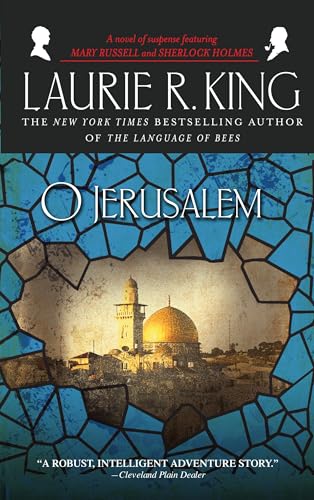
O Jerusalem by Laurie R. King (A Mary Russell and Sherlock Holmes mystery)

Anyone familiar with the Sherlock Holmes canon, or even  Christopher Morley's wonderful introduction to it, knows one of Sir Arthur Conan Doyle's most delightful and infuriating tricks was to open an adventure story with a tantalizing hint about another adventure that, alas, never got written down.

Watson always had an acceptable excuse for this, of course. There simply wasn't enough time, or the details of the case were classified or the mystery involved persons so distinguished the tale simply could not be put to paper during Watson's lifetime due to national security interests. Or, the case notes were locked in a vault in the bank.

Of course, we Holmesians (or Sherlockians, since, irritatingly, no one seems to bother with the distinction anymore) loved Holmes and Watson all the more for it.

King has taken a different tack in the fifth installment of the Mary Russell Sherlock Holmes pastiche series, giving us an entire volume dedicated to an adventure only alluded to in The Beekeeper's Apprentice.

And it is a treat.

Much like in The Moor, Holmes and Russell spend much of the book wandering in early 20th century Palestine drawn into a mystery that, naturally, brings us a glimpse of T.E. Lawrence, Gen. Edmund "Bull" Allenby and two spies-cum-Bedouin guides.

Both the guides are well developed characters, fascinating in and of themselves and keep the story going even during long, rather dry stretches of travel. King uses them as vehicles to explain Arabic and Bedoiun culture, but thankfully the pair never become caricatures of themselves, a tricky feat King pulls off exceedingly well.

Those who have studied Middle Eastern history or culture (I should admit here that I did, both before and during college, and of course afterwards to the extent I can) will appreciate King's discernment in what she chooses to highlight and use during the course of her novel.

The mystery itself was pretty good, though not great by mystery reader standards, laden with international intrigue and coated with a likely bitter resentment that stems from the fallout of World War I. There is a fun, but subtle, reference to Moriarty (though he has nothing to do with adventure, of course) that readers of the Canon will appreciate.

Perhaps because there are four characters, or perhaps because it pre-dates Russell and Holmes' marriage, or (quite possibly) because I have been fascinated with the Middle East long before current events threw it into our headlines daily, I found this to be an wonderful, immersive reading experience.

All of King's usual skill – character creation and development, historical research blended artfully into a fictitious story, sweeping settings and vivid landscapes – are present in this book.

I found Sherlock to be, as usual, as close to himself as can be expected in a pastiche and Russell's religious devotion and passion softens the edges of both their cold, analytic minds. 


The passage in which Russell describes seeing the Dome of the Rock for the first time from a hill above Jerusalem, as a Jewish woman, is beautiful and moving. But at no point is Russell proselytizing, either.

I have always found Russell's interest and academic devotion to theology, and her sincere comfort in religion, to be a wonderfully balancing counterpoint to Holmes' sometimes icy, but crystalline clear, vision of the world. It is one of the things that keeps me reading the series and in this book I found that attribute shone brilliantly.

Another of King's talents this installment illustrates more than others is her ability to keep the reader in the story using realistic detail in her character's stream of consciousness. For example, Russell has to get used to eating while in a kneeling position and, due to all the walking they do in desert, gets badly blistered feet. King never forgets these facts but doesn't dwell on them unduly, either. It helps gives a sense of time.

Though Mycroft is hinted at, the reader is disappointed. Sigh. Although Caleb Carr did an impressive job with Mycroft in The Italian Secretary, I would like to see how King handles him.

Perhaps the next installment.

Monday, November 18, 2013

A Lesson in Secrets by Jacqueline Winspear (A Maisie Dobbs mystery)

We  historical mystery readers can be a pedantic, finicky lot. As a general rule, we don't do well with the passage of time. We want our detectives, investigators and heroes to remain in the Victorian, Edwardian or whatever era in perpetuity, solving mysteries during years that only move forward in passing mention, if at all.

I admit to being guilty of the same stodginess. I get rather nervous when an author brings another technological invention or historical event into my series.

But Jacqueline Winspear has impressed me in A Lesson in Secrets, the latest installment in the Maisie Dobbs series. Although the low rumble of impending World War II was already heard in the previous book, A Mapping of Love and Death, Winspear avoids a common mistake made by authors who chose to deal with the rather tricky decades between the wars in Europe.

That is, she remembers that Maisie, and indeed everyone around her, wouldn't yet think of the Nazis as the personification of evil in 1932, when the book takes place. Winspear does an excellent job showing  that for those just trying to make a living in the tattered economy after World War I, the politics and policies of Germany and Austria were skimmed headlines and background noise to the pressing needs of everyday life.

Winspear deals with dichotomy creatively. She puts Maisie on special assignment for the British Secret Service, placing her in an undercover position as a professor. Maisie is assigned to merely observe the school, founded by a notorious pacifist, in duly inform the Crown about anything going on that may be against their interests, a rather vague assignment.

Naturally, the murder of the college's founder inevitably draws Maisie into another hornet's nest entirely, leaving her navigate the secret service, run her business from afar and solve a murder she's been ordered not to investigate.

By putting Maisie at an academic institution, Winspear deftly gives Maisie, and by extension the reader, a plausible lens through which to examine the events happening on the continent, without any of the inadvertent, righteous hindsight that authors are inevitably forced to confront when writing about the mid- to late-1930s. This is deftly done primarily through discussion between characters and is some of the best period piece writing I have ever seen.

For example, Priscilla, Maisie's upper-crust close friend who drove an ambulance during World War I, casts a wary eye at the German political landscape, but primarily from a fear for her young sons, who are inching towards being old enough to serve in the armed forces. Having lost four brothers in the Great War, Priscilla's fear is palpable but not overwrought or written with any kind of prescient foreknowledge of events to come.

Other highlights of this read include more appearances by Detective Chief Superintendent Robert MacFarlane, who is quickly becoming one of the most interesting characters this rich series has to offer.

Notable character development also occurs with Maisie's father and Maisie's own relationship with James Compton is examined.

However, a kind of sub-plot arc involving Sandra, a former servant of the Comptons, is rather neglected. Maisie can't solve it herself and the story mostly unfolds through phone calls with her assistant, Billy. Because of that, what could be an equally interesting, if secondary, story line, becomes a bit distracting and feels more like an interruption than a separate plot arc.

Also, the last two installments in the series had me a bit concerned Maisie was becoming a bit of a Mary Sue. And while this installment in the series has much to recommend it, I fear Maisie is still walking dangerously close to that line.

Mary Sues are modestly perfect in every way, always of sound judgement and, naturally, coincidentally having whatever talent or ability a given situation calls for, like speaking an esoteric language or just happening to know about the migratory patterns of birds. In short, boring in their often ridiculous preparedness.

Granted, I don't read Maisie Dobbs expecting the gritty, hyper-realistically flawed characters that Denise Mina or Tana French create. That's an entirely different style of mystery, if not a exactly a separate genre. But that being said, Winspear is too talented to let such a wonderful character become two-dimensional.

Winspear seems to address this by making it clear she and James are not waiting for wedding bells to consummate their relationship.  Actually, she makes it a bit too clear, though not through any explicit scenes (yes, a young adult can more than safely read this). Still, it's brought up often enough with comments from other characters that one wants to say, "We get it, already. They're in a conjugal relationship."

But, given the time period, in a way that was a bit rebellious, as is Maisie being a woman entrepreneur and investigator. So perhaps I am being a bit harsh on Winspear in this regard. Still, I think it would be refreshing to see Maisie be bad, or at least not good, at Math or something.

This book also highlights how Masie still goes about trying to solve her assistant's and father's and everyone else's problems. It's not a problem that she does good deeds and finds deft ways to help those she cares about with her new wealth, exactly, but the fact that no one but her father seems to lash out against her flat-out meddling is a bit implausible.

Still, a solid entry into what is still a great series. For once, I am actually looking forward to seeing what impact the march of time and World War II has on the wonderful characters Winspear has created.

Sunday, January 8, 2012

The Moor by Laurie R. King (Mary Russell and Sherlock Holmes)


The fourth installment of the Mary Russell and Sherlock Holmes series proved to be a surprising disappointment, despite Holmes and Russell’s return to Dartmoor, scene of the very infamous crime that took place in front of  Baskerville Hall which was well-chronicled by, of course, Sir Arthur Conan Doyle.

We begin with Russell firmly ensconced at Oxford and working on her theological studies while Holmes is, ostensibly, away on a case. A telegram arrives from Holmes summoning her to the moor. She, of course, folds it and returns to her studies—only to be interrupted a few moments later by another telegram asking her to leave again.

Of course, she goes, and finds herself the guest of the Reverend Sabin Baring-Gould, a rector who lives in a rambling pseudo-Elizabethan monstrosity and fancies himself the squire of Dartmoor and its residents. He has asked Holmes to look into sightings of ghostly carriage, followed by a huge dog with a glowing eye, and the murder of a moor resident.

So, Russell and Holmes spend much of the book tramping around the unwelcoming, foggy, cold, wet and harsh moor, attempting to interview its residents about the victim and the sightings. Alternately, Russell reads some of the many volumes produced by the aging and infirm squire, who has a very close—but inexplicable to Russell—relationship with Holmes.

King does deliver in her writing—the reader truly feels as though they, too, are lost in the pea-soup fog or trudging in bracken and liable to step in a bog and sink at any moment. When respite is offered in the form of stops to local pubs or in front of the fire in Baring-Gould’s study, the comfort and relief is equally felt.

But the plot was not really all that complex nor the mystery all that difficult or interesting. The characters are mildly intriguing, but with the exception of the “witch of Mary Tavy,” I found them all very lacking compared to who King has given us in the previous books in the series. And when drawn parallel to young Henry Baskerville and Stapleton, they seem down right cardboard.

All this would be alright, but there simply isn’t enough character development (virtually none, really; Holmes and Russell’s marriage remains distant and still feels sterile, despite tasteful hints of conjugal relations) to drive the novel on that alone. Even the big reveal of why Holmes has such high regard for the reverend isn’t all that earth-shattering, and I thought Russell’s level of shock upon discovering it was out of character for her.

Admittedly, some of this may be the fact that I simply am not that interested in the real-life Rev. Baring-Gould, who (as in the novel) did care deeply about the moor, was a prolific writer and did, in fact, collect the songs and folklore of the area. King said she was drawn to center a novel around him because one of his grandson wrote the “definitive biography” of Sherlock Holmes (Sherlock Holmes of Baker Street: A Life of the World’s First Consulting Detective, by William S. Baring-Gould) using Baring-Gould’s life as a model for Sherlock’s. (In the interest of full disclosure, I have not read the biography; I'm content knowing about Dr. Bell and Doyle's internship under him). 

And Baring-Gould the elder’s life does seem like it was interesting: apparently his parents travelled widely, taking their son with them and essentially using the world for his education. But, for whatever reason, this premise simply wasn’t enough for me to be fully engaged in the book. Yes, Baring-Gould is well-written, and yes, the real-life man was clearly passionate about the moor, but I simply couldn’t connect. The excerpts from his books that head off each chapter began to grow tedious for me.

All in all, the novel wasn’t unreadable or terrible. And as fans of character mystery series know, each new installment is always a bit fraught, especially when the standard has been set as high as King has set hers. I certainly enjoyed what I learned about the moor and certain scenes of the book did linger. But for all of that, I just can’t help but think that perhaps King set her sights a bit too high in deciding to use The Hound of the Baskervilles for her first selection of the canon into which to weave her characters. 

Tuesday, December 27, 2011

Birds of a Feather by Jacqueline Winspear

This installment in the Maisie Dobbs is particularly interesting for the light it sheds on a little-known role women played in the movement to have more of England's young men enlist...and shows the subtle ripple effect the encouragement of war without the understanding of it can have. 


The title comes from the British practice by women to give men who were not enlisted in the armed forces a feather as a symbol of the man's supposed cowardice. Many women believed that they really were helping their country by giving the army more men. And of course, plenty of them had little idea of the utter massacre that was taking place in the trenches at the Front in France. 


We learn a bit more about her assistant, Billy--the veteran sapper-- in this novel, and the character development will definitely keep fans of the series on the hook. However, the mystery itself is a tad slow and plodding. This series seems to be developing into one in which the character development is as much an impetus to keep buying the next book as the mystery itself. 

Maisie Dobbs by Jacqueline Winspear (Maisie Dobbs)


This is a great series. Maisie Dobbs is a smart, intuitive and strong female character who uses body language and Eastern meditation to get to the heart of suspects' minds and motives. After serving as a nurse in the first World War and apprenticing under a the highly-respected government consultant, Maurice, Maisie is hanging out her own shingle as a "psychologist and investigator."

This first book is nicely done as two stories--that of Maisie's upbringing and of her coming of age during the Great War-- folded in to one and is also probably one of the best introductory books to a series I've read in a very long time.

Friday, December 23, 2011

A Test of Wills by Charles Todd (Ian Rutledge)


I read this in one sitting, and knew immediately it was one of those series of which I had to buy the next book even if it meant going without cigarettes for a while.

The haunted Ian Rutledge, a former officer who served in the muddy of trenches of World World I, and Hamish, the young soldier he was forced to shoot for insubordination after he refuses to lead more men above the ridge and into the slaughter, are such complex characters that their internal struggles (if Hamish can be said to have internal struggles anymore) are as riveting as the beautifully executed mystery.

The war is over, but Rutledge, released from the mental institution, returns to his job as a Scottland Yard inspector a haunted man--literally. He is dogged by the relentless hallucination of Hamish, always present, always following him, muttering disdainfully in Ian's ear. Ian knows Hamish is dead, that it is merely a reflection of his shattered mental health, but the hallucination is too vivid too ignore. So Ian struggles to drown Hamish out, to not answer him aloud, and--most importantly for the context of the time--to appear sane. His supervisor already despises Rutledge, so it won't take much of a slip up to end up fired, only increasing the pressure on Rutledge's pained and restless mind.

Post-WWI-England is vividly portrayed with little (but well-researched and well-placed) details. Passing comments made by the characters in this series often linger for quite some time. Absorbing both for the characters and the mystery (with wonderfully classic--yet not cliche--touches), this series is one of those that will have many readers waiting impatiently for the next installment.

Saturday, December 17, 2011

The Beekeeper's Apprentice by Laurie R. King (Mary Russell and Sherlock Holmes)

As a devout Sherlockian (I re-read the Canon every November), I am always highly skeptical of pastiches. So I was wonderfully flabberghasted when I found myself completely immersed in this book.

Laurie King's Holmes has aged seamlessly and Mary Russell, with her youth, independence, and American upbringing is a perfect counterpoint for him. The dialogue, particularly Holmes', never seemed stilted or forced (as it often is when contemporary authors choose to resurrect him), Watson remains true to the best parts of his character, and even Mycroft is handled well.

Every setting in the book, from Oxford to Palestine, is beautifully painted with broad strokes. The narrative style pulls the reader in in a way that reminded vaguely of Chaim Potak or Steinbeck.

I was hoping to enjoy this book, though I did not expect to-- I knew my own purist, pedantic heart might not allow it (details, misquotes, false portrayals of character...they niggle at my brain so when reading Holmes pastiches). Instead I found myself loving it and eagerly awaiting the next Holmes and Russell adventure.

Among the Mad by Jacqueline Winspear (Maisie Dobbs)

Although I enjoy the Maisie Dobbs series and will continue to read these book, I must say this was not one of my favorite installments. 


This book takes Maisie deep into the world of mental health care in the early 1930s. A disenfranchised war veteran who is able to make chemical weapons is threatening to attack the entire city within a matter of days and has, inexplicably, mentioned Maisie Dobbs in the first of several threatening letters. When dead animals that have apparently been gassed begin to show up, the race against the clock becomes all the more urgent. 


Thus Maisie is brought under the umbrella of the Special Branch and MI-5 and even has a tete a tete with the PM, all while racing to save the city. 


There wasn't enough mystery, to put it bluntly. Although Winspear has, as always, thoroughly researched the time period and how mental health was administered, it was fairly obvious from the beginning what was going on. There is some good character/plot development with the Beales, however. 


Fans of the series will enjoy this book, as I did, but it may not be the most memorable of Maisie's adventures.

A Duty to the Dead by Charles Todd (Bess Crawford)

Charles Todd's new series--also set after World War I--features a bright, sharp female protagonist, Bess Crawford. Bess, raised by her military father and mother, was brought up mostly in India and consequently offers a unique perspective on London, the war, and people's general attitude towards it. 


Fans of Todd's Ian Rutledge series will recognize the wonderful writing style, vivid imagery, and subtle commentary on the ravages of the War to End All Wars. As Bess is a nurse, much of carnage is witnesses first hand and the effect of the war on women is excellently highlighted through Bess' sometimes almost harsh observations. 


However, Bess--having a good relationship with her parents, a fierce independent streak, and solid common sense--is a much lighter protagonist than Ian Rutledge. She is not yet haunted by the war and suffers from no physical or psychological injury (that we know of yet). That being said, Todd still manages to capture the darkness that shrouded England during the time, and Bess is not chipper or perky. She will certainly have demons to deal with, but she does not carry them about with her. 


As such, I am looking forward to Charles Todd's next installment in this series.

Friday, December 16, 2011

A Letter of Mary by Laurie R. King (Mary Russell and Sherlock Holmes)

Another successful installment of the Mary Russell series. Those who already love the series will not be disappointed, and although it is fine as a stand-alone novel, I don't know that I could recommend it as an introduction to the series. 


Although this story doesn't take Holmes or Russell very far outside of London in terms of travel, it nonetheless has all the hallmarks of every book thus far in the series: an excellent portrayal of an older Holmes, an intriguing puzzle to be solved, wonderfully vivid characters, and an absorbing narrative. 


However, I with this book would have shed a bit more light on Russell's scholarly theological work. Her interest in theology serves as a nice counterpoint to Holmes' disregard of it and deserves to be explored more in depth.


This is especially true given that much of the plot centers around Mary's growing fascination with a Margaret, a woman who draws her deeper into a cult-like group that seems to have mystical powers. 

Saturday, December 10, 2011

A Mapping of Love and Death by Jacqueline Winspear (Maisie Dobbs)


In this latest installment of the Maisie Dobbs series, Jacqueline Winspear does not disappoint.

Maisie finds herself investigating the death of an American cartographer who joined the British Army at the onset of WWI in 1914. When his remains are uncovered, he is found in possession of meticulously preserved letters from a woman who only signs her name as "The English Nurse" or "Tennie." His parents, established members of the Boston Brahmins, journey to London and hire Maisie to track down the mysterious woman with whom their son had a war-time affair.

But of course, it's not as simple as that, especially when Maisie reads the coroner's report and begins to suspect that it was not a shell and trench collapse that killed young Michael Clifton after all...

Devoted readers should be warned there is a bit of heartbreak in this book. Several of the character story lines have surprising developments, and Maisie herself forays cautiously once again into love.

Winspear--perhaps even more so than other authors--captures the undercurrent rumblings of the next impending war exceptionally well. She retains her vivid imagery and immersing sense of time and place. All in all, another satisfying read from a very pleasant and interesting series.